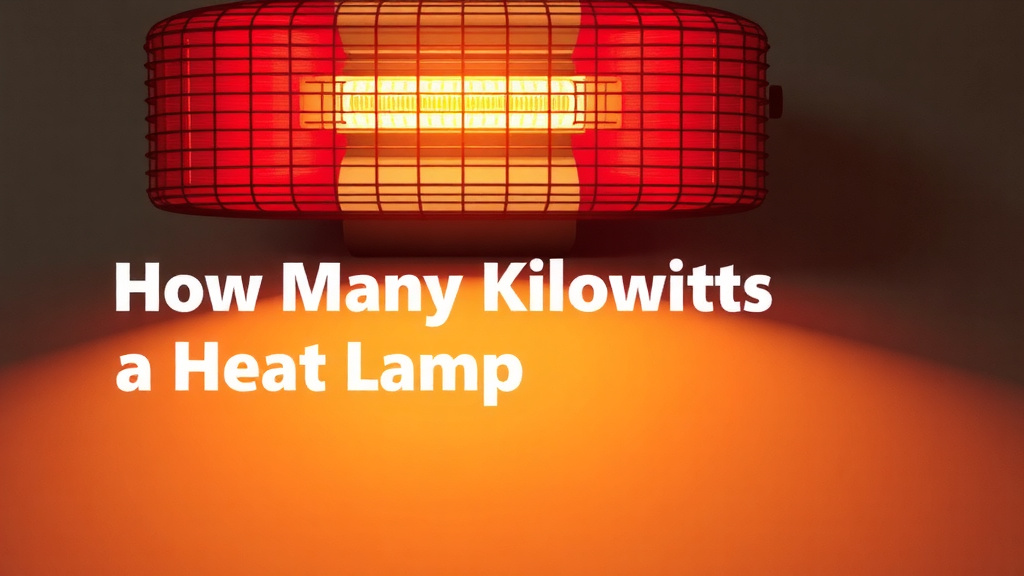
How Many Kilowatts Does a Heat Lamp Use? Energy Guide
A typical heat lamp uses between 0.25 and 1.5 kilowatts of electricity per day, depending on the bulb wattage and how long you run it. Most standard heat lamps draw 250 to 500 watts per hour, which means one kilowatt-hour for every two to four hours of use. That’s actually less than you might think!
We researched common heat lamp setups for bathrooms, reptile tanks, and chicken coops, and we found that wattage varies a lot by purpose. The bigger question isn’t just how many kilowatts it uses, but what that means for your electric bill. Trust us, the math is easier than your high school algebra class was.
- Most heat lamps run between 150 and 500 watts per hour.
- A 250-watt bulb used 4 hours a day costs roughly $4 to $6 per month.
- Heat lamps for pets and livestock often run longer, raising the cost.
- Bathroom heat lamps use less power but warm small spaces fast.
- Simple habits like timers can cut your usage without losing warmth.
Below, we break down everything you need to know about heat lamp power usage, including real cost examples and easy ways to lower your bill. Let’s dig in.
Heat Lamp Power Use in Kilowatts Explained
Let’s start with the simple math. A heat lamp’s wattage tells you how much power it draws each hour. Divide that number by 1,000 and you get kilowatts. So a 250-watt bulb uses 0.25 kilowatts every hour it runs.
Think of it like water flowing through a hose. The wattage is how fast the water flows. The hours you run it is how long you leave the spigot open. Both matter for your bill.
- 150 watts = 0.15 kilowatts per hour
- 250 watts = 0.25 kilowatts per hour
- 375 watts = 0.375 kilowatts per hour
- 500 watts = 0.5 kilowatts per hour
How Much Electricity Different Heat Lamps Draw
Not all heat lamps are created equal. We found that the wattage depends heavily on what the lamp is actually warming. A reptile tank needs far less power than a chicken coop in January.
Here’s a quick breakdown of common setups so you can find yours.
| Heat Lamp Use | Typical Wattage | Kilowatts per Hour |
|---|---|---|
| Reptile tank bulb | 50–150 watts | 0.05–0.15 |
| Bathroom heat lamp | 250 watts | 0.25 |
| Food warming lamp | 250–375 watts | 0.25–0.375 |
| Chicken coop lamp | 250–500 watts | 0.25–0.5 |
| Double-bulb bathroom unit | 500–750 watts | 0.5–0.75 |
Why Wattage Ranges Vary So Much
Bulb style plays a big role. Infrared bulbs, ceramic emitters, and halogen bulbs all pull different amounts of power. Ceramic heat emitters, for example, are popular for reptiles because they give off heat without light.
The fixture matters too. Some bathroom units hold two or three bulbs at once. That can double or triple your draw in a hurry.
What a Heat Lamp Costs on Your Electric Bill
Here’s the part you really care about. The average US household pays roughly 16 to 17 cents per kilowatt-hour, according to the US Energy Information Administration. Your exact rate depends on your state and utility company.
Let’s run a real example. A 250-watt heat lamp running 4 hours a day uses 1 kilowatt-hour daily. At 16 cents, that’s about $5 per month. Not bad, right?
Cost Examples by Daily Usage
| Bulb Wattage | Hours per Day | Monthly Cost (at $0.16/kWh) |
|---|---|---|
| 150 watts | 4 hours | About $3 |
| 250 watts | 4 hours | About $5 |
| 250 watts | 12 hours | About $14 |
| 500 watts | 12 hours | About $29 |
| 500 watts | 24 hours | About $58 |
Notice how runtime matters more than wattage in most cases. A modest bulb left on all day can cost more than a powerful bulb used briefly. That’s the sneaky part.
Heat Lamp Costs for Chickens, Reptiles, and Pets
If you’re keeping animals warm, your lamp probably runs long hours. Baby chicks often need heat for 6 to 8 weeks, and many keepers run lamps around the clock during that period. Reptile owners may run basking bulbs 10 to 12 hours daily to mimic daylight.
Proper temperatures matter for animal health, so we don’t recommend cutting corners here. The CDC notes that young livestock and poultry are especially sensitive to cold stress. But smart scheduling can still save you money.
Smart Ways to Lower Animal Heat Lamp Costs
- Use a thermostat or thermostat-controlled outlet so the lamp only runs when needed.
- Switch to ceramic heat emitters, which are often more efficient than incandescent bulbs.
- Insulate the coop or enclosure so heat stays where you want it.
- As chicks feather out or animals acclimate, taper hours down gradually.
Bathroom Heat Lamps: Small Space, Quick Warmth
Bathroom heat lamps are the sprinters of the heat lamp family. They use 250 watts or so per bulb, but they only run for 10 to 20 minutes at a time. That short burst costs pennies.
Many experts point out that radiant heat feels warm on your skin right away, even if the air itself hasn’t heated up yet. That’s why these lamps feel effective despite their modest output. Flip it on while you dry off, flip it off when you leave. Easy. Curious why radiant heat feels instant? Our guide to how infrared heat lamps work breaks it down.
Do Bathroom Heat Lamps Use a Lot of Power?
Short answer: no, not if you use them briefly. A two-bulb unit drawing 500 watts for 15 minutes daily uses about 0.125 kilowatt-hours per day. That’s under $1 per month in most states.
Kilowatts vs. Kilowatt-Hours: A Quick Refresher
These two terms trip up a lot of people, so let’s clear it up. A kilowatt is a measure of power at one moment. A kilowatt-hour measures energy used over time, and it’s what your bill charges for.
Your utility company never bills you for kilowatts alone. They bill kilowatt-hours. So when you calculate cost, always multiply kilowatts by the hours you ran the lamp.
Tips to Cut Your Heat Lamp Energy Use
Want to keep the warmth and skip the sticker shock? We put together a simple checklist based on what energy experts and animal care guides commonly recommend.
- Put your lamp on a timer so it shuts off automatically.
- Check the bulb’s actual wattage on the label — many people guess wrong.
- Use reflective fixtures to direct heat where it’s needed most.
- Seal drafts in the space so the lamp doesn’t fight losing battles.
- Consider a thermostat plug to cycle the lamp on and off.
- Clean the bulb regularly; dust can reduce heat output.
Are LED or Lower-Wattage Options Available?
Sometimes, yes. Ceramic emitters and radiant panels can deliver steady heat with different efficiency profiles. We found that ceramic heat emitters are a popular swap for reptile keepers because they last longer than incandescent bulbs.
Just make sure any replacement bulb is rated for your fixture and your purpose. Safety first, savings second. The National Fire Protection Association warns that heat lamps near flammable materials are a real fire hazard, so keep clearance around them.
How to Calculate Your Own Heat Lamp Usage
Ready to do this yourself? It takes about 60 seconds. Grab your bulb’s wattage and your average daily hours, then follow these steps.
- Find the wattage printed on the bulb or packaging.
- Divide the wattage by 1,000 to get kilowatts.
- Multiply kilowatts by your daily hours of use.
- Multiply that result by 30 for a monthly kilowatt-hour total.
- Multiply by your utility rate from your electric bill.
For example, a 375-watt food warming lamp used 2 hours daily works out to about $3.60 per month at 16 cents per kilowatt-hour. Once you’ve done it once, you’ll never second-guess a heat lamp again.
Conclusion
Now you know the numbers. Most heat lamps draw between 0.15 and 0.5 kilowatts per hour, and your real cost depends far more on runtime than wattage. A quick bathroom lamp costs you pennies, while a coop lamp running all night can add $50 or more to a monthly bill. The fix is simple: check your bulb’s wattage, track your hours, and let a timer or thermostat do the discipline for you. We found that small changes in scheduling often save more than swapping bulbs ever will. So here’s your next step: grab your electric bill, find your rate, and run the five-minute math on your own setup tonight.
Frequently Asked Questions
Can I leave a heat lamp on 24 hours a day?
You can, but it adds up fast. A 250-watt bulb running nonstop uses about 6 kilowatt-hours daily, or roughly $29 per month at average US rates. If safety and cost matter, a thermostat-controlled outlet is a smarter setup than a bulb that never rests.
Do heat lamps use more electricity than space heaters?
Usually much less. Most space heaters draw 1,500 watts, which is three to ten times more than a typical heat lamp. A heat lamp warms a small, targeted area instead of a whole room, so it’s the better pick for spot heating.
How many amps does a heat lamp pull?
Divide the wattage by your home’s 120-volt circuit. A 250-watt heat lamp pulls a little over 2 amps, while a 500-watt unit pulls about 4 amps. That’s well within a standard 15-amp circuit, but watch out if other appliances share it.
Do heat lamps use a lot of electricity when left on standby?
Not really. A switched-off heat lamp draws essentially zero power, since it’s just a bulb in a fixture with no electronics. The cost comes only from the hours it’s actually glowing, so flipping it off when you leave is all the savings you need.
Are heat lamps safe to run overnight around animals?
They can be, but take precautions. Secure the fixture so it can’t fall, keep flammable bedding clear of the bulb, and use a bulb rated for continuous use. We recommend a thermostat or a safer radiant panel option if your setup will run unattended for long stretches. For unattended chick setups, our brooder vs heat lamp guide covers the safer options in detail.