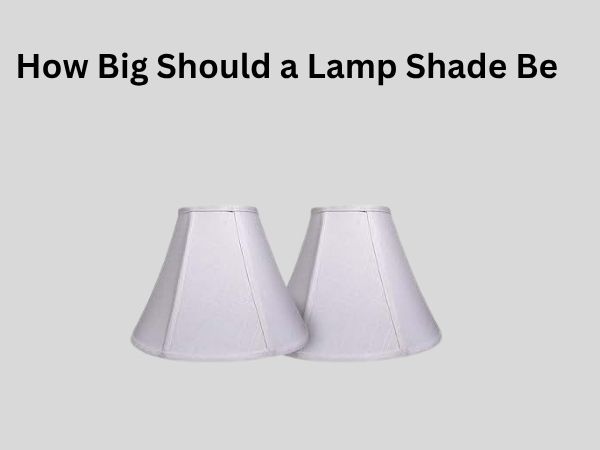
Finding the Perfect Fit: How Big Should a Lamp Shade Be for Your Light?
Have you ever walked into a room and felt like something was just… off? Maybe the lamp shade looked too small perched on top of the base, or perhaps it was so enormous it swallowed up the entire lamp. I get it. Choosing the right lamp shade size isn’t exactly rocket science, but it’s definitely an art form that many people overlook. The truth is, getting this detail right can completely transform how your lamp looks and functions in your space.
Let me be honest—when I first started decorating my home, I bought a beautiful lamp shade without measuring anything. Spoiler alert: it looked ridiculous. That experience taught me that understanding lamp shade proportions is absolutely crucial if you want to create a polished, intentional look in any room. So let’s dive into this together and figure out exactly what size lamp shade you actually need.
Why Lamp Shade Size Actually Matters More Than You Think
Before we talk measurements and percentages, let’s address why this even matters in the first place. Your lamp shade isn’t just there to look pretty—well, it is, but that’s not all it does. Think of it as the finishing piece of a puzzle. A lamp shade that’s properly sized will:
- Create balanced visual proportions in your room
- Distribute light evenly and appropriately
- Hide the bulb effectively from direct view
- Complement your lamp base instead of competing with it
- Enhance your overall interior design aesthetic
When a lamp shade is too small, you’ll typically see the bulb from certain angles, which can create an unflattering look and throw off harsh light. When it’s too large, it overwhelms the base and can actually reduce the amount of usable light in your space. It’s really about finding that sweet spot where everything works together harmoniously.
Understanding the Basic Proportional Rule for Lamp Shades
The Golden Ratio: Two-Thirds Rule
Here’s the fundamental principle that interior designers and lighting experts swear by: your lamp shade should be approximately two-thirds the height of your lamp base. I know that sounds oddly specific, but trust me, once you see it in action, you’ll understand why this works so well.
Let me explain this differently. Imagine your entire lamp—base plus shade—as one complete unit. The base should take up roughly the bottom third of that visual unit, while the shade occupies the upper two-thirds. This creates a naturally pleasing proportion that our eyes find satisfying. It’s similar to how photographers use the rule of thirds to create balanced compositions.
Calculating Your Ideal Lamp Shade Height
So how do you actually measure this? It’s simpler than you might think. Take the height of your lamp base from where it starts (typically at the widest point) to the top of the harp—that’s the metal piece that holds the shade. Once you have that measurement, multiply it by two, and you’ve got your target lamp shade height.
For example, if your lamp base is 10 inches tall, your shade should ideally be around 20 inches in height. Not exactly 20, mind you—give yourself some flexibility. The range between 18 and 22 inches would work beautifully in this scenario. Remember, we’re aiming for visual harmony, not mathematical perfection.
Measuring Your Lamp Shade Width: The Diameter Dilemma
The Diameter-to-Height Relationship
Now let’s talk width because height is only half the equation. The diameter of your lamp shade—the widest point across the opening—needs to maintain a specific relationship with the height you’ve chosen. Generally speaking, your shade’s diameter should be roughly 50 to 60 percent of its height.
Think about it this way: if you have a lamp shade that’s 20 inches tall, you’d want it to be between 10 and 12 inches in diameter at its widest point. This creates that classic, slightly tapered silhouette that looks intentional and designed, rather than random.
Common Lamp Shade Dimensions at a Glance
To make this even easier, here are some standard sizes you’ll encounter when shopping:
- Small shades: 10-12 inches diameter, 12-14 inches height
- Medium shades: 12-14 inches diameter, 16-20 inches height
- Large shades: 14-18 inches diameter, 20-26 inches height
- Extra-large shades: 18+ inches diameter, 26+ inches height
These aren’t hard rules, but they’re solid starting points when you’re browsing and trying to narrow down your options.
Different Lamp Base Types and Their Shade Requirements
Table Lamps: The Most Common Scenario
Table lamps are what most of us are dealing with in our homes. These typically sit on nightstands, side tables, desks, or console tables. For table lamps, that two-thirds rule applies perfectly. Your shade should extend noticeably above the widest point of the base but shouldn’t be so tall that it looks unstable or out of proportion.
The key with table lamps is thinking about sight lines. You want the shade to be tall enough that when you’re sitting at eye level—whether on a couch or in a chair—you don’t see directly into the bulb. Generally, the bottom edge of the shade should align roughly with the top third of the lamp base.
Floor Lamps: Playing by Different Rules
Floor lamps operate under slightly different principles. Since they start from the ground, the proportions shift a bit. With floor lamps, you’re typically looking at a smaller shade relative to the overall height of the lamp. A floor lamp that’s 60 inches tall might have a shade that’s only 14-16 inches in diameter and 10-12 inches in height.
Why? Because a floor lamp’s height is already commanding the space. Adding a proportionally large shade would make it seem top-heavy and awkward. Think of it like balancing a human body—you wouldn’t want someone with regular-sized arms and legs suddenly sprouting a gigantic head.
Accent and Decorative Lamps
Some lamps are purely decorative and live on shelves, dressers, or decorative tables. These smaller accent lamps can be a bit more flexible with proportions since they’re not necessarily providing primary lighting. However, they still benefit from maintaining visual harmony. A petite ceramic lamp with a 6-inch shade looks intentional and charming, whereas a small lamp with an 18-inch shade just looks confused.
Considering Your Lamp Shade Shape: Beyond Just Size
Cylindrical Shades: The Classic Choice
Cylindrical lamp shades—straight sides, uniform diameter from top to bottom—are traditional and work well with most base styles. Because they have consistent proportions, the sizing rules I mentioned earlier apply pretty straightforwardly. What you see is what you get with these shades.
Tapered Shades: Creating Visual Interest
Tapered shades are wider at the bottom and narrower at the top, and they’re incredibly popular for good reason. They’re forgiving with proportions and create an elegant, sophisticated look. With these, you have a bit more flexibility because the visual weight is distributed differently. You might get away with a shade that’s slightly larger or smaller than the strict mathematical proportions suggest.
Bell-Shaped Shades: Subtle Curves
Bell-shaped shades—wider in the middle, slightly narrower at top and bottom—offer another option. These work beautifully on traditional and transitional bases and add a touch of vintage charm. The curves help soften the overall look, making them less strict about size perfection.
The Relationship Between Lamp Base Width and Shade Diameter
I want to highlight something that deserves its own attention: the diameter relationship between your base and your shade. Your lamp shade’s bottom opening (or the widest point if it’s a traditional drum shade) should be roughly 1 to 1.5 times the diameter of the widest point of your lamp base.
Let’s say your lamp base is 6 inches wide at its widest point. Your shade should ideally be between 6 and 9 inches in diameter. This ensures the shade sits nicely on the lamp, covering the electrical components and harp without looking too baggy or too tight.
If the shade is too narrow, it’ll look pinched and precarious, like the shade is barely holding on. If it’s too wide, it overpowers the base and creates an unbalanced appearance. This is where shopping in person can really help, because you can actually place the shade on the lamp and see how it feels visually.
Measuring Your Existing Lamp: Step-by-Step Instructions
What You’ll Need
Grab a measuring tape (soft, flexible ones work best), a notebook, and your lamp. That’s genuinely all you need to get accurate measurements.
The Measurement Process
First, measure the height of your lamp base. Start from the bottom and measure up to the top of the harp (the metal piece that extends upward). Write this number down. Next, measure the widest point of the base—this is your base diameter. Finally, if you want to be thorough, measure the current shade’s diameter and height so you can reference them while shopping.
Take a photo of your lamp from multiple angles while you’re at it. When you’re standing in a lighting store surrounded by dozens of options, having a clear visual reference on your phone makes decision-making infinitely easier.
Room Size and Lamp Shade Proportion
Here’s something that catches a lot of people off guard: the size of your room actually influences what shade size looks appropriate. In a small bedroom, a massive lamp shade can overwhelm the space, making the room feel cramped. In a spacious living room with high ceilings, a tiny shade might look lost.
Think about it proportionally. Your lamp should feel appropriately scaled to its surroundings. In an intimate space, smaller to medium shades work best. In expansive rooms, you have more flexibility to go larger. This is one of those design nuances where stepping back and looking at the whole picture matters.
Material and Color: How They Affect Perceived Size
Light-Colored Shades and Visual Perception
Interestingly, the color and material of your shade influence how big it actually appears. Light-colored shades—whites, creams, pale yellows—tend to visually expand because light reflects off them. Dark-colored shades absorb light, making them appear smaller and heavier.
If you’re worried about your shade looking too large, choosing a darker or more saturated color can actually help. Conversely, if you want a shade to feel more substantial, opting for lighter, airier colors will enhance that effect.
Material Density and Visual Weight
Heavy, textured materials like linen or burlap feel substantial and substantial, while delicate fabrics like silk or chiffon feel lighter and airier. A large shade made of airy fabric feels less overwhelming than the same size shade in heavy linen. This is pure visual psychology, but it’s worth considering as you shop.
Common Mistakes People Make With Lamp Shade Sizing
The “Too Small” Catastrophe
This is probably the most common mistake I see. People buy a shade that’s too small, thinking it looks delicate and refined. In reality, it just looks unfinished and proportionally wrong. You’ll see the bulb, the electrical parts, and the harp—none of which should be visible. Plus, the light distribution becomes uneven and awkward.
The “Too Large” Problem
On the flip side, oversized shades are increasingly common. People fall in love with a particular shade design and buy it without measuring. While a large shade might be beautiful on its own, on a small lamp base it looks ridiculous. It’s like wearing an enormous coat on a tiny frame—it just doesn’t work.
Ignoring the Base Entirely
Some people select lamp shades purely based on aesthetics without considering their specific lamp base. You can’t just buy a shade in a vacuum. It has to work with your particular lamp. Always bring measurements or a photo when shopping.
Shopping Tips: Finding the Perfect Size
When you’re actually out there looking for lamp shades, here’s my best advice: measure twice, buy once. Seriously, I can’t stress this enough. Take your measurements, and if you’re shopping online, read the dimensions carefully and check multiple angles in customer photos.
If you’re shopping in person—and I highly recommend it for lamp shades—ask if you can actually place the shade on a display lamp that’s similar to yours. Most lighting stores have demo lamps set up. This gives you a real sense of how the shade will look without guessing.
Don’t be shy about asking store associates for help either. Good lighting stores employ people who understand proportions and can offer valuable guidance. They might suggest sizes or styles you hadn’t considered.
Adjusting for Different Harp Heights
Here’s a detail that often gets overlooked: the height of your harp can affect how you calculate proportions. If you have an unusually tall or short harp, it slightly changes where your shade sits on the lamp.
Most standard harps are about 3-4 inches tall, but some lamps have longer harps for specific aesthetic reasons. If your harp is particularly tall, you might want your shade slightly larger to maintain visual balance. Conversely, a short harp might call for a slightly smaller shade. It’s a subtle adjustment, but it matters when you’re trying to achieve that perfect look.
When to Break the Rules (Yes, Really)
I’ve been giving you guidelines and rules, but here’s the truth: design guidelines exist to help us, not imprison us. If you absolutely love a shade that’s slightly larger than “proper” proportions, and it brings you joy, then buy it. Your home should make you happy.
That said, breaking the rules works best when you’re doing it intentionally and with awareness. You know what the standard proportions are, and you’re deliberately choosing something different for a specific reason. That’s different from accidentally buying something that’s the wrong size.
I’ve seen plenty of rooms where a slightly oversized or undersized shade worked beautifully because of the overall design scheme. Just make sure you’re making an intentional choice, not just guessing.
Conclusion
Choosing the right lamp shade size might seem like a small detail in the grand scheme of interior design, but it genuinely makes a significant difference. By following the two-thirds rule for height, maintaining appropriate diameter proportions, and considering your specific lamp base and room context, you’ll end up with a lamp that looks intentional, balanced, and beautiful.
Remember: your lamp shade should be roughly two-thirds the height of your lamp base, with a diameter that’s 50-60% of the shade’s height. The shade’s bottom opening should be 1 to 1.5 times the width of your lamp base’s widest point. These guidelines give you a solid foundation for making confident decisions.
Take your time when shopping, measure carefully, and don’t hesitate to ask for help. Your lamp might seem like a minor element in your room, but when it’s properly proportioned and styled, it becomes a wonderful accent that ties your space together. Now go find that perfect shade, and enjoy creating a beautifully balanced room.

![10 Best Battery Powered Desk Lamp [2026]](https://bestdesklamp.com/wp-content/uploads/2026/08/10-best-battery-powered-desk-lamp-2026-featured-768x432.jpg)
![10 Best Budget Nail Lamp [2026]](https://bestdesklamp.com/wp-content/uploads/2026/08/10-best-budget-nail-lamp-2026-featured-768x432.jpg)