How Big Should a Lamp Be on a Table: The Ultimate Guide to Perfect Lighting Proportions
Have you ever walked into a room and felt like something was just off about the lighting? Maybe the lamp on your nightstand looked tiny compared to your dresser, or perhaps that floor lamp you bought dwarfs your entire side table setup. Getting the right lamp size isn’t just about aesthetics—it’s about creating balance, functionality, and an inviting atmosphere in your space.
I’m going to walk you through everything you need to know about selecting the perfect lamp size for your table. Think of this as your personal interior design consultant, right here in your pocket, helping you make smart decisions about one of the most important accessories in your home.
Understanding Table Lamp Proportions: Why Size Really Matters
When we talk about lamp sizing, we’re not just throwing darts at a wall and hoping something sticks. There’s actual logic behind it. Your lamp needs to work in harmony with your table, your room’s overall scale, and the purposes you need it to serve. A lamp that’s too small will look lonely and won’t provide adequate light. A lamp that’s too large will overwhelm the space and create visual clutter.
Think of it like this: imagine wearing oversized clothing to a formal dinner. It doesn’t matter how nice the clothes are—they just don’t fit right. The same principle applies to lamps and tables.
The Basic Rule: The One-Third Height Principle
Here’s the golden rule that interior designers swear by, and honestly, it works like a charm. Your table lamp’s total height—including the lampshade—should be approximately one-third the height of the surface it’s sitting on, or more specifically, one-third the height of whatever’s behind it, whether that’s a headboard, wall, or furniture piece.
So if your nightstand is 28 inches tall, your lamp should ideally be around 9 to 10 inches. If your console table is 36 inches, aim for a lamp that’s roughly 12 inches in height. This creates what designers call visual balance, and it’s surprisingly effective at making rooms feel intentional and well-designed.
Why This Rule Exists
Our eyes naturally respond to proportion. When objects follow mathematical relationships, they feel harmonious to us, even if we can’t quite put our finger on why. This one-third rule taps into that natural human preference for balance. It’s been used in architecture and design for centuries because it genuinely works.
Measuring Your Table: Getting the Numbers Right
Before you can apply any sizing rules, you need to know your table’s actual dimensions. Here’s what you should measure:
- The height of your table from floor to surface
- The length and width of the tabletop
- The height of any furniture or wall features behind the table
- The overall room dimensions for context
Grab a measuring tape and jot down these numbers. Seriously, this takes five minutes and saves you from making costly mistakes. I’ve seen too many people buy lamps online without measuring, only to regret it when delivery arrives.
Understanding Different Table Types
Different tables have different requirements. Let me break down the most common scenarios you’ll encounter.
Nightstand Lamps
Nightstands are typically 24 to 30 inches tall. For these, you want a lamp that’s on the smaller side—usually between 18 and 24 inches total height including the shade. This ensures the lamp doesn’t block your view when you’re lying in bed, and it creates a cozy, proportional look. The lamp should be shorter than or roughly equal to the height of your headboard’s visual weight, not taller than it.
Desk and Console Table Lamps
Desks and console tables run taller, usually between 28 and 36 inches. Here, you can accommodate larger lamps—think 24 to 32 inches total height. These spaces benefit from more substantial lighting because people are typically working at these surfaces and need better visibility. A bigger lamp also looks less lost on a wider workspace.
Entryway and Foyer Tables
Entry tables are all about making a statement. They’re usually quite tall and often have dramatic styling. For these, you might go slightly larger than the one-third rule suggests—maybe 30 to 40 percent of the backdrop height—because you want the lamp to be a focal point that welcomes people into your home.
The Lampshade Diameter: Another Critical Measurement
Here’s something people often overlook: the lamp’s height is only part of the equation. The shade’s diameter matters just as much for proportions and function.
A good rule of thumb is that your lampshade should be about two-thirds the height of the lamp’s base (the part below the shade). If your lamp base is 15 inches tall, your shade should be roughly 10 inches in diameter. This creates visual harmony and ensures adequate light distribution.
Shade Width in Relation to Your Table
Your lamp shade’s width should never exceed the width of your table. If you have a 24-inch wide nightstand, your lamp shade shouldn’t be wider than about 20 inches. Ideally, it should be about 60 to 70 percent of your table’s width. This prevents the lamp from appearing to float dangerously on the edge or from overwhelming the table surface.
Room Size and Lamp Scale: The Bigger Picture
Your room’s overall dimensions play a significant role in lamp selection. A lamp that looks perfect in a cozy bedroom might disappear in a grand master suite. Conversely, a large decorative lamp that commands attention in a small guest room might feel imposing in a larger space.
Small Rooms and Compact Spaces
In smaller rooms, you want proportionally smaller lamps. These spaces benefit from delicate, refined lighting fixtures that don’t eat up visual real estate. Go lighter, more minimal, and slightly smaller than the basic rule might suggest. You’re working with limited space, so every object needs to earn its place.
Large Rooms and Open Layouts
Spacious rooms can handle—and often demand—larger lamps. A tiny lamp in a vast master bedroom just looks lonely and lost. Don’t be afraid to scale up. Oversized lamps often become statement pieces in generous spaces, adding character and visual weight where it’s needed.
Function First: Why You’re Using the Lamp Matters
Let’s talk purpose. Are you using this lamp primarily for task lighting, ambient lighting, or decoration? This fundamentally changes what size works best.
Task Lighting Requirements
If you’re reading, working, or doing detailed tasks, you need a lamp large enough to house adequate lighting power. Smaller lamps often have limited shade size, which means less light diffusion. For a desk lamp, you might actually want to go bigger than the standard one-third rule to ensure you have enough light. A 32-inch lamp on a 36-inch desk provides both good proportions and excellent functionality.
Ambient Lighting Considerations
Ambient lamps create mood and general illumination. These can be slightly smaller because they’re not expected to be primary light sources. A beautifully proportioned 20-inch lamp on a nightstand that supplements your overhead lighting can be perfectly adequate, even if it’s smaller than the strict mathematical rule.
Decorative Lamps and Visual Impact
Some lamps are statement pieces first, lighting sources second. These can be larger and more dramatic. An eye-catching 36-inch ceramic base lamp on a console table creates an impressive focal point, even if it slightly exceeds standard proportions. As long as it doesn’t look cartoonishly oversized, a bit of drama is perfectly acceptable.
Style and Design Aesthetics: How Visual Weight Affects Perception
Here’s something subtle but important: a delicate, thin-based lamp appears smaller and more elegant than a squat, chunky lamp of the same height. Visual weight matters. A spindly lamp can be taller than a solid lamp while still looking proportional.
Minimalist and Modern Styles
Contemporary design often features sleek, vertical lines. These lamps can push toward the taller end of the scale because their slim profiles don’t feel overwhelming. A 28-inch modern lamp might feel lighter and more appropriate than a 24-inch traditional lamp with a much wider base.
Traditional and Transitional Designs
Classic lamps tend to have more substantial bases and wider shades. These benefit from slightly more conservative sizing to avoid looking top-heavy. Stick closer to the one-third rule with these styles.
Industrial and Eclectic Styles
Industrial lamps thrive on drama and scale. These styles give you permission to bend the rules. An oversized industrial lamp can look intentional and cool rather than awkward.
The Two-Lamp Scenario: Balancing Pairs on Your Table
What if you’re placing two lamps on a long console table or on opposite sides of a bed? The rules shift slightly, but the principle remains the same.
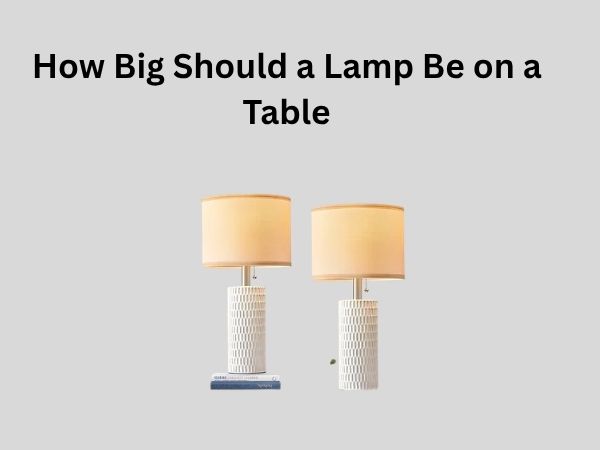
Both lamps should be identical in size and style for symmetry. They should still follow the one-third height rule individually, but because you have two focal points instead of one, you might actually get away with slightly smaller lamps than you’d use if placing a single lamp. The pair creates visual weight together.
Leave adequate space between them—typically at least 18 to 24 inches on a standard console table. This prevents the table from feeling cluttered and allows each lamp to breathe visually.
Common Mistakes People Make When Selecting Lamp Sizes
I’ve watched countless people struggle with lamp sizing, and certain mistakes come up repeatedly. Let me help you avoid them.
Going Too Small Out of Caution
Many people err on the side of too-small lamps because they’re afraid of the lamp being too large. This creates a timid, unfinished look. Your room ends up feeling empty rather than balanced. Don’t be shy. Go appropriately sized.
Ignoring the Shade in Proportion Calculations
People sometimes focus only on the lamp base height and forget that the shade adds significant visual bulk. You need to account for the entire assembled lamp when measuring against your table height.
Choosing Based Solely on Online Photos
That lamp might look perfect in the product photo, but you have no sense of scale from a picture. Online photos are deceptive. Always check the actual measurements before ordering.
Not Considering Placement Location
A lamp that’s proportionally perfect for a centerpiece position might look awkward pushed to the corner. Think about where the lamp will actually sit on your table.
Testing Before You Buy: Smart Shopping Strategies
You don’t have to buy blindly. Here are ways to test lamp sizing before committing.
- Visit showrooms and see lamps in person next to tables
- Use the augmented reality features on furniture websites when available
- Create a cardboard mock-up the approximate size of your intended lamp
- Ask about return policies before purchasing
- Measure your space and bring those measurements shopping with you
Taking these extra steps prevents expensive returns and ensures you get a lamp that actually works in your space.
Budget Considerations: Big Doesn’t Always Mean Expensive
Here’s good news: proper sizing doesn’t require breaking the bank. You can find perfectly proportioned lamps at every price point. A well-proportioned lamp from a budget retailer looks infinitely better than an improperly sized lamp from a luxury brand.
Don’t let price dictate your sizing decisions. Stay focused on proportions first, then find products that fit your budget within that size range.
Lighting Quality and Lamp Size: A Practical Connection
Larger lamps typically accommodate larger light bulbs and more sophisticated electrical components, which can mean better lighting quality. A properly sized lamp not only looks better—it often functions better too. The shade has more surface area to diffuse light, creating softer, more pleasant illumination.
This is another reason the one-third rule works so well. It’s not arbitrary; it results in lamps that are functionally superior in most scenarios.
Adjusting the Rules for Unique Situations
Rules are guidelines, not laws. Certain situations call for flexibility.
Very Tall Ceilings and Lofty Spaces
In spaces with dramatic vertical proportions, you can often go larger than standard rules suggest. The height around you is greater, so proportionally larger lamps feel appropriate.
Narrow, Deep Tables
For console tables that are quite deep but narrow, you want a lamp with a vertical emphasis rather than horizontal spread. A slightly taller, narrower lamp maintains proportions better than one that emphasizes width.
Tables with Prominent Backsplashes or Mirrors
When your lamp sits in front of a mirror or vertical wall feature, it becomes visually doubled. You might want to go slightly smaller to account for this visual multiplication.
The Role of Lamp Base Style in Overall Proportion
The lamp base’s design influences how large or small the whole piece feels. A lamp with an ornate, detailed base appears busier and potentially larger than its measurements suggest. A sleek, minimalist base feels lighter and more elegant.
When choosing between two lamps of similar height, the one with the slimmer base will look more graceful and proportional, especially in smaller spaces.
Conclusion
Selecting the right lamp size for your table doesn’t require special expertise or expensive consultations. You just need to understand a few key principles and take accurate measurements of your space.
Remember the golden rule: aim for a lamp height that’s roughly one-third the height of your table or the furniture behind it. Pay attention to your lamp shade’s diameter relative to your table width. Consider your room’s overall scale, the lamp’s function, and your design style. And most importantly, don’t be afraid to bring your measurements shopping or to verify dimensions carefully before purchasing online.
The difference between a room that looks accidentally decorated and one that looks intentionally designed often comes down to these small details. Properly proportioned lamps create visual harmony, improve functionality, and transform how a room feels. You’ve got this—go forth and find the perfect lamp for your space.
Frequently Asked Questions
What if my table is unusually tall or short—should I still use the one-third rule?
The one-third rule is flexible and serves as a guideline rather than a strict mandate. If your table is unusually tall, you might go slightly larger to maintain visual balance. For unusually short tables, go slightly smaller. The key is ensuring your lamp doesn’t look disproportionately large or comically tiny. Use the rule as a starting point, then adjust based on your specific situation and how it looks in your actual space.
Can I place a floor lamp next to a table lamp in the same area?
Absolutely, but use different heights for each. If you have a 24-inch table lamp, pair it with a floor lamp that’s at least 48 inches or taller. This creates visual interest through variation. Keep the lamp bases proportional to their respective surfaces, so the table lamp follows the one-third rule for its table, and the floor lamp relates appropriately to the room
![10 Best At Home Led Gel Nail Lamp [2026]](https://bestdesklamp.com/wp-content/uploads/2026/08/10-best-at-home-led-gel-nail-lamp-2026-featured-768x432.jpg)
![10 Best Bulb For Desk Lamp [2026]](https://bestdesklamp.com/wp-content/uploads/2026/08/10-best-bulb-for-desk-lamp-2026-featured-768x432.jpg)