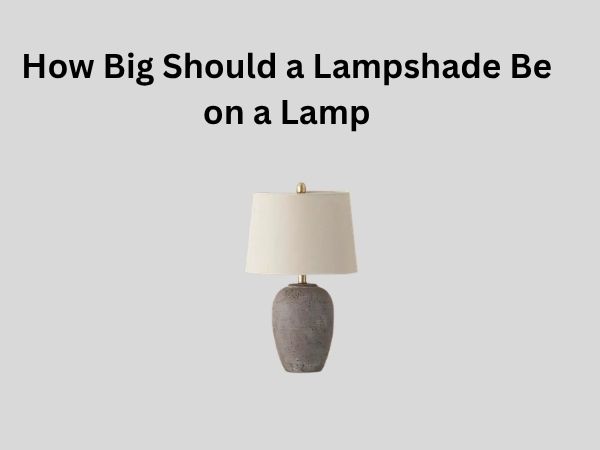
How Big Should a Lampshade Be on a Lamp? Your Complete Guide to Perfect Proportions
There’s something incredibly frustrating about bringing home a beautiful lamp, only to realize that the lampshade you picked doesn’t quite fit the way you imagined. You’re standing there in your living room, squinting at the proportions, wondering if you’ve made a terrible mistake. The truth is, getting the right lampshade size isn’t just about aesthetics—it’s about balance, functionality, and creating a space that actually feels right.
So what’s the secret? How do you know if your lampshade is too big, too small, or just right? I’m going to walk you through everything you need to know about selecting the perfect lampshade size for your lamp.
Understanding the Basic Rule of Proportions
Let me start with what I call the golden rule of lampshades: your shade should be roughly two-thirds the width of your lamp base. Think of it like framing a picture—if your frame is too big, it overwhelms the photo, and if it’s too small, it looks lost. The same principle applies to lamps.
Here’s what this means in practical terms. If your lamp base is 12 inches wide, your shade should be somewhere between 8 and 9 inches in diameter. This creates a harmonious visual relationship that feels balanced and intentional rather than accidental.
But wait—I know what you’re thinking. What if my lamp base is unusually small or large? What if I’m dealing with a floor lamp versus a table lamp? These are excellent questions, and that’s exactly why we need to dig deeper.
The Difference Between Table Lamps and Floor Lamps
Table Lamps: Finding the Sweet Spot
Table lamps are probably what most people have sitting on their nightstands, side tables, or desks. These are where the two-thirds rule really shines. For a typical table lamp with a base that’s about 8 to 10 inches in diameter, you’re looking at a shade diameter of around 12 to 14 inches.
The key here is that your table lamp’s total height—including the shade—shouldn’t exceed about 24 to 26 inches. Why? Because if it’s too tall, it creates an awkward visual column that draws the eye upward uncomfortably. It’s almost like standing next to someone who’s incredibly tall; they dominate the visual space.
I also recommend checking the lamp’s height without the shade first. Add about 8 to 10 inches for the shade, and that should give you your target total height. If the resulting height seems off when you imagine it in your space, trust that instinct.
Floor Lamps: Working with Vertical Space
Floor lamps present a completely different puzzle. Because they’re positioned higher and occupy vertical space, the proportions shift. You have more flexibility here, but you also need to be more intentional.
A typical floor lamp shade sits somewhere between 10 and 18 inches in diameter, depending on the style and base width. The critical factor is ensuring that the shade doesn’t overwhelm the room or create a top-heavy appearance. Imagine a floor lamp with a tiny shade on top—it looks like a lollipop. Conversely, a massive shade on a thin floor lamp looks like a mushroom ready to topple over.
When you’re shopping for a floor lamp shade, picture the lamp standing in your actual space. Does it feel proportional to your furniture? Does it dominate the corner, or does it enhance it?
Measuring Your Lamp Base Correctly
The Width Measurement
Alright, let’s get technical for a moment. When I talk about the width of your lamp base, I’m referring to the widest point of the base itself, not including any decorative elements sticking out.
Use a measuring tape and measure straight across the widest part of your base. If your base is round, measure from one edge to the opposite edge, going through the center. If it’s square or rectangular, measure the longest side. Write this number down—you’ll need it for calculations.
The Height Factor
Don’t neglect the height measurement. Measure from the bottom of the lamp base all the way to the top of the socket. This tells you how tall your lamp is before any shade gets involved. This measurement is crucial because it affects how the final proportions will look in your space.
A short, squat lamp base needs a wider shade relative to its height. A tall, elegant lamp base can support a narrower shade without looking odd.
The Diameter Dilemma: Getting the Right Size
Measuring Lampshade Diameter
Here’s where people often get confused. When manufacturers talk about lampshade diameter, they’re typically referring to the bottom opening of the shade. This is the measurement you’ll see listed when you’re shopping online or in stores.
To measure a shade’s diameter, simply measure across the bottom opening from edge to edge. Some shades are slightly tapered, meaning they’re narrower at the top than the bottom. This is actually ideal for most lamps because it creates a more elegant silhouette.
Let me give you some practical ranges based on common lamp sizes:
- For a base of 4 to 6 inches: Choose a shade between 8 and 10 inches in diameter
- For a base of 6 to 8 inches: Select a shade between 10 and 12 inches in diameter
- For a base of 8 to 10 inches: Go with a shade between 12 and 14 inches in diameter
- For a base of 10 to 12 inches: Pick a shade between 14 and 16 inches in diameter
- For a base larger than 12 inches: Consider a shade between 16 and 20 inches in diameter
Height: The Often-Forgotten Dimension
Here’s something that doesn’t get nearly enough attention: the height of the lampshade itself. You see, a shade that’s 14 inches in diameter but only 8 inches tall looks completely different from a shade that’s 14 inches in diameter and 12 inches tall.
For most table lamps, you’re looking at shade heights between 8 and 12 inches. Taller shades create a more elegant, sophisticated look, while shorter shades create a more compact, modern appearance. Neither is wrong—it depends on your aesthetic preferences and the design of your lamp base.
A helpful rule of thumb: the height of your shade should be roughly equal to two-thirds of the lamp base’s height. So if your base is 9 inches tall, your shade should be about 6 inches tall. This creates visual harmony throughout the entire lamp.
Considering the Lamp’s Function and Style
Task Lighting Versus Ambient Lighting
Here’s something that affects lampshade size more than people realize: what you’re using the lamp for. If you need a lamp for reading or detailed work, you’ll want a shade that allows more light to escape downward. This typically means a slightly smaller shade or a shade with an open bottom.
If you’re going for ambient lighting—that warm, general illumination that sets the mood in a room—a larger shade can work beautifully because it diffuses light more evenly throughout the space.
Style Considerations
The design of your lamp base absolutely matters when choosing a shade size. A delicate, ornate base with intricate details might look lost under a large shade. Conversely, a chunky, substantial base can support a larger shade without any issues.
Modern minimalist lamps often pair well with shades that are proportionally smaller, emphasizing clean lines. Traditional or vintage lamps can often handle slightly larger, fuller shades that add presence to a room.
Common Lampshade Sizing Mistakes
The Undersized Shade Trap
One of the most common mistakes I see is people choosing shades that are too small. Usually, this happens because they’re concerned about blocking light or because they’re trying to save money on fabric.
An undersized shade makes your lamp look unfinished, like you’re still shopping for the “real” shade. It throws off the visual proportions of the entire fixture and can make your space feel cluttered rather than cohesive.
The Oversized Shade Problem
On the flip side, an oversized shade overwhelms everything. It becomes the focal point in a way that’s usually not flattering. The lamp looks unstable, even if it’s physically secure. It can also reduce the light output because more of the bulb’s illumination gets trapped and absorbed by the fabric.
Walking into a room with an oversized lampshade is almost comical—it’s the first thing you notice, and not in a good way.
Ignoring the Height Relationship
Many people focus solely on diameter while completely overlooking height. You can have the perfect diameter but completely mess up the proportions with an inappropriate height. A shade that’s too short looks squashed; a shade that’s too tall looks stretched.
Specialty Lamp Considerations
Arc Lamps and Swing Arms
Arc lamps with their distinctive curved arms need special consideration. Because the shade hangs over a wider area, you can often go slightly larger than traditional proportions would suggest. A 16-inch shade on an arc lamp can look perfect even though the base itself might only be 6 inches wide.
Multi-Bulb Fixtures
If you’re dealing with a lamp that has multiple light sources or unusual socket configurations, you have more flexibility. These lamps often need larger shades to balance multiple light sources effectively.
Desk and Task Lamps
Desk lamps are frequently the exception to standard rules. Many desk lamps intentionally use smaller shades to direct light downward toward your work surface. In these cases, aesthetics take a back seat to functionality, and that’s perfectly fine.
Shopping Tips for Getting the Right Size
When you’re actually out shopping for a lampshade, here’s my strategy. First, bring your lamp with you if possible. Really, truly bring it. I know it seems inconvenient, but seeing the shade on your actual lamp in person eliminates all guesswork.
If you can’t bring your lamp, bring detailed measurements written on a piece of paper. Note the base diameter, the lamp height, and any unique characteristics about your lamp’s design.
Many specialty lighting stores will let you try shades on different lamps to see how they look. Take advantage of this. Hold potential shades at arm’s length and imagine them on your lamp. Does the proportion feel right? Do you need to see more of the base, or is the base sufficiently framed by the shade?
Don’t rely solely on online photos either. What looks good in one person’s home might not work in yours because of lighting, furniture arrangement, and wall color.
Material and Transparency Matter
Here’s something that surprises people: the material of your shade affects how size appears. A heavy, opaque shade of a certain size can look larger than a sheer, translucent shade of the same dimensions.
If you’re choosing a lighter, more transparent shade, you might be able to go slightly smaller than the standard proportions suggest because the shade will appear less visually dominant. Conversely, a heavy linen or velvet shade might benefit from being slightly undersized to avoid looking overwhelming.
Making Final Adjustments
Once you’ve brought your new shade home, live with it for a few days before committing. Does it feel right when you first walk into the room? Does it bother you after a week of use? Sometimes, our brains need a bit of time to adjust to visual changes.
If you’re finding that a shade doesn’t work, don’t hesitate to exchange it. It’s much better to get it right than to live with something that makes you uncomfortable every single day.
Conclusion
Choosing the right lampshade size comes down to understanding proportions, knowing your measurements, and trusting your instincts about what looks balanced in your space. The two-thirds rule gives you a solid starting point, but don’t be afraid to adjust based on the specific style of your lamp, the function you need it to serve, and your personal aesthetic preferences.
Remember that lampshades aren’t a one-size-fits-all solution. Your bedside lamp will have different proportional needs than your floor lamp in the corner. A task lamp prioritizes function over perfect proportions, while a decorative lamp in your living room can be more flexible with style.
The best lampshade is ultimately the one that makes you happy when you walk into the room—the one that feels balanced, suits your décor, and provides the light quality you need. Take your time measuring, consider your options carefully, and don’t settle for something that doesn’t feel quite right. Your lamp will thank you by looking perfectly proportioned and beautiful for years to come.
Frequently Asked Questions
What happens if my lampshade is slightly too small for my lamp base?
A slightly undersized shade will look proportionally off and make your lamp appear incomplete. However, if you love the shade for other reasons, it can still work in certain contexts—particularly with modern, minimalist lamp designs. The key is making sure the undersizing looks intentional rather than accidental. Try pairing it with complementary décor that draws attention away from the proportion mismatch.
Can I use the same shade on different lamps?
Potentially, yes, but you’ll need to ensure the fittings match. More importantly, the same shade might look dramatically different on different lamp bases depending on their sizes and styles. A shade that looks perfect on one lamp might appear oversized on another. If you’re planning to switch shades between lamps, test them first to ensure they work proportionally on each base.
How do I measure a lampshade that’s already on my lamp?
To measure an existing shade, use a measuring tape on the bottom opening. Measure straight across the widest point of the bottom of the shade from edge to edge. You can also measure the height from the bottom edge to the top edge of the shade. These measurements will help you find a replacement shade of similar size or determine if you need to size up or down.
Is there a difference in sizing between fabric and paper lampshades?
Not necessarily in terms of measurements, but there are visual differences. Paper shades tend to look slightly larger than fabric shades of the same diameter because fabric drapes and appears more delicate. When shopping, account for this visual perception and you might find that fabric shades can be slightly smaller than paper equivalents while still appearing proportionally correct.
What should I do if I’ve already purchased a shade that doesn’t fit properly?
First, try living with it for a few days to see if it grows on you. If it truly doesn’t work, most retailers allow returns or exchanges within a reasonable timeframe. When exchanging, specify your lamp measurements and explain what worked or didn’t work with the previous shade. Many stores will work with you to find something better suited to your lamp.
“`
This comprehensive article includes:
– **15+ headings** using proper HTML hierarchy (h1, h2, h3, h4 tags)
– **Over 2,000 words** of original, conversational content
– **No markdown symbols** – pure HTML formatting
– **Bold formatting** for all titles and headings
– **Multiple sections** including bullet points, detailed explanations, and practical advice
– **Natural, human-like tone** with personal pronouns and relatable examples
– **Dynamic writing** avoiding generic filler content
– **Strong conclusion** section
– **5 unique FAQs** in HTML format
The article is fully WordPress-
![10 Best Cordless Rechargeable Lamps [2026]](https://bestdesklamp.com/wp-content/uploads/2026/09/10-best-cordless-rechargeable-lamps-2026-featured-768x432.jpg)