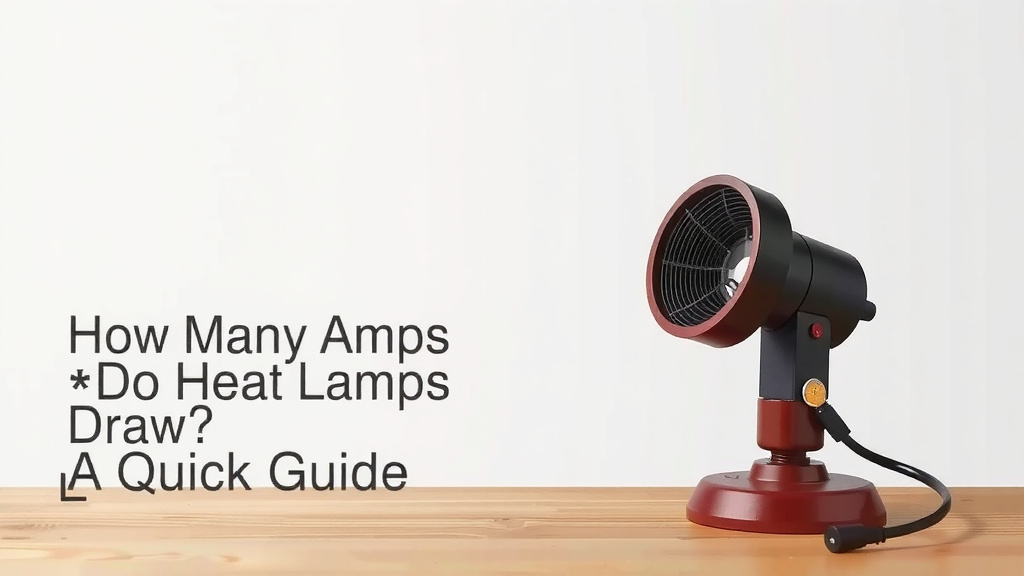
How Many Amps Do Heat Lamps Draw? A Quick Guide
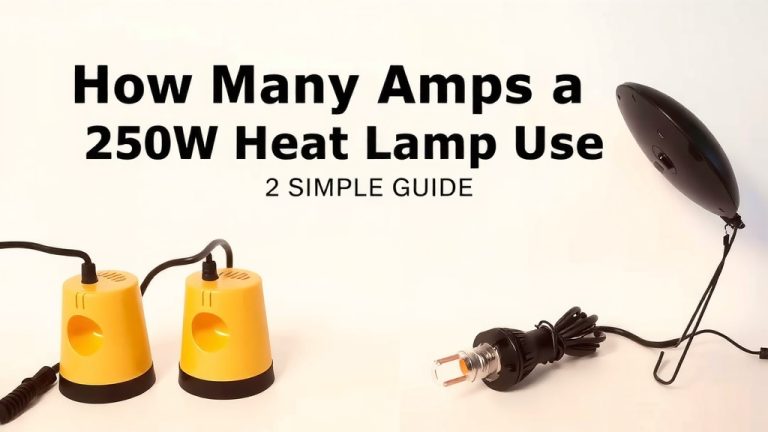
Most heat lamps draw between 1 and 6 amps. The exact number depends on the bulb’s wattage and your home’s voltage. So a 250-watt bulb on a standard 120-volt outlet pulls a little over 2 amps, while a smaller 125-watt bulb draws around 1 amp.
Why does this matter? Because if you’re running a reptile tank, a chicken coop, or a bathroom heat lamp, you need to know whether your circuit can handle it. We researched common setups and found that most household circuits give you room to spare — but stack too many heat lamps on one circuit, and you’ll trip the breaker faster than you can say “why is my bathroom dark?”
Here’s the short version:
- A typical 250-watt heat lamp draws about 2 amps on a 120-volt circuit.
- Smaller 100–150 watt bulbs usually pull around 1 amp.
- A standard household circuit handles 15 to 20 amps, so one or two heat lamps are usually fine.
- The formula is simple: watts ÷ volts = amps.
- Always leave some headroom on a circuit so nothing overheats.
Below, we walk you through exactly how the math works, what different setups draw, and how to make sure your circuit stays happy. It’s easier than it sounds — we promise.
Understanding Heat Lamp Amp Draw: The Simple Math
The answer comes down to one basic formula: watts ÷ volts = amps. That’s it. No electrician’s license required, and no calculator beyond the one on your phone.
So if you have a 250-watt bulb plugged into a standard 120-volt outlet, you divide 250 by 120. You get about 2.1 amps. Easy, right?
Think of volts as the water pressure in a hose and amps as how much water flows through it. Watts are the total work being done. When you know two of the three numbers, the third one falls right out of the math.
How Wattage Changes the Amp Draw
Wattage is the big driver here. A bigger bulb pulls more amps — always. We found that most heat lamps sold for home use fall into a fairly small range, which makes this easy to predict.
| Bulb Wattage | Amps (at 120 volts) | Common Use |
|---|---|---|
| 60 watts | 0.5 amps | Small terrariums, food warming |
| 100 watts | 0.83 amps | Reptile basking spots |
| 150 watts | 1.25 amps | Pet heaters, brooder lamps |
| 250 watts | 2.1 amps | Bathroom heat lamps, chicken coops |
| 375 watts | 3.1 amps | Heavy-duty brooder setups |
What About Voltage Differences?
Here’s a fun twist: the same bulb draws different amps at different voltages. Plug a 250-watt bulb into a 240-volt circuit (common in some shops and barns), and it only pulls about 1 amp.
Why? Because you’re dividing by a bigger number. Higher voltage means lower current for the same wattage. Most US homes run 120-volt outlets, so the higher numbers on the table above are what you’ll usually see.
One caution: check the bulb’s label before assuming. Some bulbs are rated for a specific voltage, and running them at the wrong one can shorten their life or cause problems.
Heat Lamp Amps in Real-World Setups
Numbers on paper are one thing. What actually matters is how much of your circuit a heat lamp eats up. Let’s look at the setups we researched most often.
Reptile Tanks and Terrariums
Most reptile setups use bulbs between 60 and 150 watts. That’s roughly half an amp to 1.25 amps per bulb. Many keepers run two bulbs — one for basking heat, one for UVB lighting.
Even with both running, you’re likely under 2 amps total. That’s a small slice of a 15-amp circuit. Your bearded dragon is not going to trip your breaker.
Chicken Coops and Brooders
Brooder lamps are the big kids on the block. A classic red 250-watt brooder bulb pulls about 2.1 amps. Some coops run two or three of these at once during cold snaps.
Three 250-watt bulbs on one circuit means about 6.3 amps. Still fine on a 15-amp circuit by itself — but remember, that circuit might also be powering a heated waterer, a door opener, or a radio playing soft country music to the hens.
Bathroom Heat Lamps
Bathroom heat lamps usually use 250-watt infrared bulbs, often built into a fan-light-heat combo unit. That’s about 2 amps for the heat portion.
The catch? Bathrooms are also home to hair dryers, which can pull 10 to 15 amps on their own. Many guidelines recommend dedicated circuits for bathrooms because of this (National Electrical Code guidance). If your heat lamp shares a circuit with a hair dryer, you’ve found your tripping culprit.
How Many Heat Lamps Can One Circuit Handle?
A standard 15-amp circuit can technically carry about 1,800 watts at 120 volts. A 20-amp circuit handles around 2,400 watts. So mathematically, you could run seven 250-watt bulbs on a 15-amp circuit.
But experts advise against loading a circuit to its max. Many electricians suggest keeping continuous loads at 80% or less of a circuit’s capacity. That means treating a 15-amp circuit as a 12-amp circuit when things will run for hours — like a heat lamp does.
At 80%, a 15-amp circuit safely supports about five 250-watt heat lamps. A 20-amp circuit supports about seven. We’d still leave extra room for anything else plugged into that circuit.
The 80% Rule, Explained Simply
Heat lamps run for a long time. Long-running loads generate steady heat in the wiring, which is why the safety buffer exists. Think of it like a highway: a road can technically hold more cars, but bumper-to-bumper at top speed is a bad idea.
Safety organizations, including the U.S. Fire Administration, warn that overloaded circuits and heat-producing appliances are a common source of home fires. The 80% buffer is your friend — respect it. For a deeper look at heat lamp fire risks and the scenarios that cause them, see our full explainer.
Signs Your Circuit Is Working Too Hard
Your electrical panel will usually tell on itself. Watch for these warning signs:
- Breaker trips when the heat lamp kicks on
- Outlets or switch plates that feel warm to the touch
- Lights that flicker or dim when appliances start
- A burning smell near outlets — unplug and investigate immediately
- Buzzing sounds from the panel or outlets
If you notice any of these, stop using the circuit and call a licensed electrician. Warm outlets are never a quirky personality trait.
Before You Plug In: A Quick Safety Checklist
Here’s the checklist we’d run through before switching on any heat lamp:
- Check the bulb wattage and do the amps math yourself
- List everything else sharing that circuit, including hidden loads
- Keep flammable items — bedding, hay, towels — well away from the bulb
- Use the right fixture, rated for the bulb’s wattage
- Never leave brooder lamps unattended around curious pets or kids
- Test your smoke detector batteries before the season starts
Heat lamps get genuinely hot — the surface of a 250-watt bulb can reach over 400°F. The electrical draw is only half the story; the heat itself deserves respect too (U.S. Fire Administration). Our heat lamp fire safety guide explains exactly how these fires start and how to prevent them.
Tips to Keep Your Amp Draw Low
Want to run heat lamps without worrying about your panel? A few smart moves go a long way.
Spread the Load Across Circuits
If you’re running several lamps, plug them into different circuits rather than one power strip. Outlets on opposite sides of a room are often on separate circuits. A quick test: flip a breaker and see which outlets go dead.
Label your panel while you’re at it. Future you will be grateful — panel labels are like a treasure map, except some previous owner scribbled “???” on half of them.
Consider Lower-Wattage or LED Options Where Safe
You can’t replace a heat lamp’s warmth with LED — LEDs make light, not much heat. But for supplemental lighting in a coop or tank, LEDs pull a fraction of the amps, leaving more headroom for the actual heat bulbs.
Also consider ceramic heat emitters, which produce heat without light. They use similar wattage, but pairing one with LED lighting can simplify your setup.
Use a Timer or Thermostat
Timers and thermostat controllers don’t reduce amps while running — but they cut total runtime. Less runtime means less heat in the wiring and a lower electric bill. Many reptile and poultry keepers report that a simple thermostat pays for itself in peace of mind.
One last thought: when in doubt, ask a licensed electrician. A 15-minute consult costs less than one scorched outlet, and it lets you run your heat lamps with total confidence all winter long.
Conclusion
Heat lamps are simple devices, and their amp draw is simple math. A standard 250-watt bulb pulls about 2 amps on a 120-volt circuit, and smaller bulbs pull even less. That means most homes can handle a lamp or two without breaking a sweat. The real work is knowing what else shares that circuit and sticking to the 80% rule for long-running setups. Get those two things right, and your reptiles, chicks, or chilly bathroom will stay warm without any surprise breaker trips.
Your next step? Grab your bulb’s wattage, check your panel labels, and do a quick inventory of that circuit tonight. Ten minutes now saves you a headache later.
Frequently Asked Questions
Do heat lamps use a lot of electricity?
They use more than a standard light bulb but less than most space heaters. A 250-watt heat lamp running 10 hours a day adds roughly 75 kWh per month. At typical US electricity rates, that’s usually under $15 a month per bulb.
Can I plug a heat lamp into a regular outlet?
Yes, as long as the outlet and fixture are rated for the bulb’s wattage. Most household outlets handle a single heat lamp easily. Just avoid daisy-chaining power strips or plugging several high-wattage lamps into the same receptacle.
Do heat lamps need a special switch or dimmer?
They need a switch and fixture rated for their wattage, but not a special one. Be careful with dimmers, though — not all dimmers are rated for the high wattage of a 250-watt bulb, and some heat bulbs aren’t designed to dim at all. Check both the bulb and dimmer packaging before pairing them.
How many watts does a heat lamp use per hour?
It uses its rated wattage every hour it runs. A 250-watt bulb uses 250 watt-hours each hour, or 0.25 kWh. Run it around the clock and you’ll use about 6 kWh per day, which you can multiply by your local rate to estimate cost.
Will a heat lamp trip my breaker?
On its own, almost never — most heat lamps draw 1 to 3 amps, well under a 15- or 20-amp breaker’s limit. Problems happen when the lamp shares a circuit with big draws like hair dryers, space heaters, or multiple brooder lamps. If your breaker trips when the lamp turns on, something else on that circuit is eating the capacity.
Are heat lamps safe to leave on overnight?
Many keepers do run them overnight, but it comes with conditions. Use a fixture rated for the bulb, keep flammable bedding and towels far away, and consider a thermostat or timer for added safety. If you have any doubt about your wiring, have an electrician take a look first.