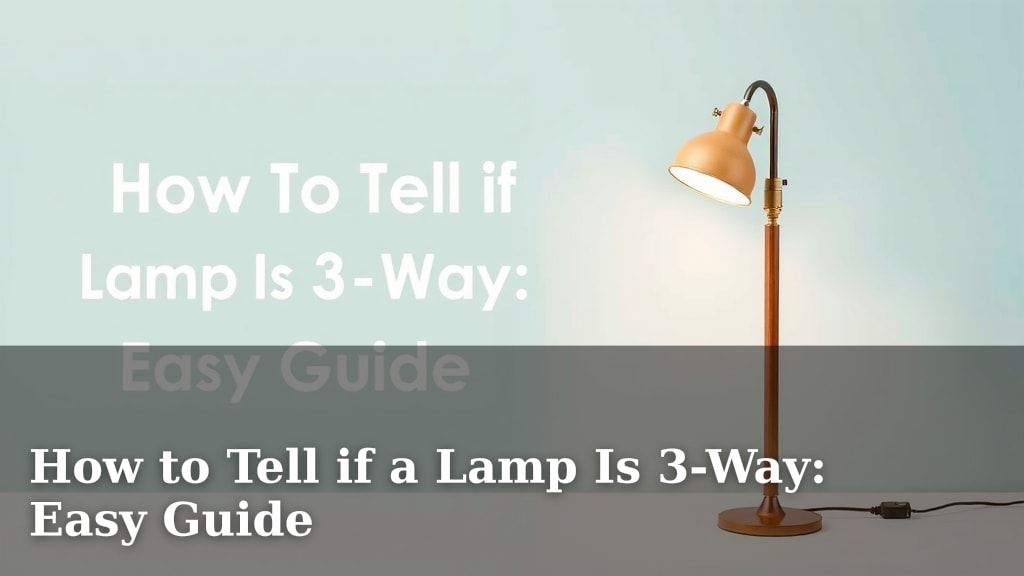
How to Tell if a Lamp Is 3-Way: Easy Guide
You can tell if a lamp is 3-way compatible by looking at its light bulb socket and its switch. A 3-way bulb socket typically has three contact points inside, and the switch will have multiple settings like “1,” “2,” “3,” and “Off.”
Many lamps are designed for standard bulbs, but 3-way lamps offer variable lighting options for different moods or tasks. Identifying your lamp’s capability ensures you buy the right bulbs and get the most out of its features. It’s a simple check that saves you time and frustration.
- Look at the light bulb socket for three metal contact points.
- Check the switch for multiple settings (e.g., 1, 2, 3, Off).
- A 3-way bulb is required for this type of lamp.
- Standard lamps only have one brightness setting.
Let’s walk through exactly how to check your lamp’s features so you can enjoy its full lighting potential!
Checking Your Lamp for 3-Way Capabilities
So, you’ve got a lamp and you’re wondering if it’s one of those fancy 3-way types. It’s actually pretty straightforward to figure out! Think of it like checking a phone – you just need to know where to look. We’ll guide you through the simple steps to confirm if your lamp offers those multiple brightness settings.
The Switch Tells the Tale
Your lamp’s switch is often the easiest indicator. Many standard lamps have a simple on/off switch. Some might have a dimmer that you slide or twist. A 3-way lamp’s switch, however, usually has distinct positions. These are typically labeled with numbers like “1,” “2,” “3,” and then “Off.”
When you operate a 3-way switch, you’ll feel distinct clicks as you move through the settings. Each click corresponds to a different light level. The first click might be the lowest setting, the second a medium, and the third the brightest. This is the most common design for these types of lamps.
What to Look For on the Switch
Keep an eye out for these specific markings:
- Physical Positions: Does the switch have multiple distinct positions you can feel or see?
- Number Markings: Are there numbers like “1,” “2,” “3,” or “Low,” “Medium,” “High” printed on or near the switch?
- Rotary Dials: If it’s a rotary switch, does it have clear steps or click points beyond just on and off?
Examining the Light Bulb Socket
The inside of your lamp’s light bulb socket holds another key clue. Standard lamps usually have a simple two-contact design. A 3-way lamp socket, on the other hand, is a bit more complex to accommodate the different filament settings on a 3-way bulb.
If you carefully look inside the socket (make sure the lamp is unplugged first, of course!), you’ll notice the metal contacts. A 3-way socket typically has three metal contact points. These contacts are essential for delivering power to the different parts of the 3-way bulb’s filament. It’s like having three lanes on a highway instead of just two!
Identifying the Socket Contacts
Here’s what you’re looking for:
- Unplug First: Safety first! Always unplug the lamp before inspecting the socket.
- Three Contacts: You should see three small metal pieces inside the socket. One is usually at the very bottom center, and the other two are on opposite sides of the socket’s inner wall.
- Standard Socket: A regular lamp socket will usually only have the center contact at the bottom and possibly one on the side.
The Bulb Itself Can Be a Hint
While not a definitive check for the lamp, the bulb you are currently using can also offer some insights. If you find a bulb that is labeled “3-Way,” it’s a strong indication that your lamp is designed to use it. These bulbs are specifically made with multiple filaments.
These special bulbs are usually a bit larger than standard incandescent bulbs and have three distinct wattage ratings printed on them. For example, you might see “50/100/150W” printed on the glass. This means the bulb can operate at three different brightness levels when used in a compatible 3-way lamp.
What to Look for on a Bulb Package
When you’re shopping for bulbs, check the packaging for these keywords:
- “3-Way Bulb”
- Three wattage numbers (e.g., 30/70/100W)
- Compatibility information stating it’s for 3-way lamps
| Feature | Standard Lamp | 3-Way Lamp |
|---|---|---|
| Switch Type | Simple On/Off or Dimmer | Multi-position (e.g., 1, 2, 3, Off) |
| Socket Contacts | Typically 2 contacts | Typically 3 contacts |
| Bulb Requirement | Standard incandescent, LED, or CFL | Requires a 3-Way Bulb (with multiple filaments) |
| Brightness Settings | One setting | Multiple settings (e.g., low, medium, high) |
When in Doubt, Check the Manufacturer Information
Sometimes, the quickest way to be absolutely sure is to look for any manufacturer labels or markings on your lamp. These are often found on the lamp’s base, near the power cord, or sometimes on the harp that holds the lampshade.
If you can find a sticker or an engraved plate, it might specify the lamp’s features. Look for terms like “3-Way” or details about the wattage it supports. If the information is unclear or missing, don’t worry! The switch and socket checks are usually very reliable.
What If Your Lamp Isn’t 3-Way?
If you’ve gone through these steps and your lamp doesn’t show the signs of a 3-way system, it’s likely a standard lamp. That’s perfectly fine! Standard lamps are designed for simple, single-brightness bulbs. You’ll just need to pick up a regular light bulb that fits the socket and your desired brightness and color temperature.
Using a 3-way bulb in a standard lamp won’t damage the lamp or the bulb, but it won’t give you the multi-level lighting. The lamp will only function at its single, maximum brightness setting, regardless of the bulb’s capabilities. It’s like putting a sports car engine in a golf cart – it has potential, but the vehicle isn’t built to use it.
Quick Checklist: Is Your Lamp 3-Way?
Here’s a handy checklist to quickly confirm:
- Unplugged lamp? (Safety first!)
- Switch has numbers (1, 2, 3)?
- Switch has multiple distinct clicks?
- Socket has three metal contacts inside?
- Current bulb is a 3-way type? (Optional, but a clue)
If you answered “yes” to most of these, congratulations! Your lamp is ready for the convenience and flexibility of 3-way lighting. If not, you have a reliable standard lamp, and now you know exactly what to look for in your next purchase if you desire those extra settings!

Conclusion
You’ve now learned the simple tricks to figure out if your lamp is 3-way compatible. By checking the switch for numbered settings and looking inside the socket for three metal contacts, you can easily tell the difference. Knowing this helps you choose the right bulbs and enjoy adjustable lighting in your home. Don’t guess anymore; a quick visual inspection is all it takes to understand your lamp’s lighting potential. Grab a 3-way bulb and set the perfect mood for any occasion!
Frequently Asked Questions
Can I use a regular bulb in a 3-way lamp?
Yes, you can usually use a standard single-wattage bulb in a 3-way lamp. However, the lamp will only operate at its brightest setting. You won’t get the benefit of the multiple brightness levels a 3-way bulb offers.
What happens if I put a 3-way bulb in a standard lamp?
If you put a 3-way bulb in a standard lamp, it will likely function at its highest brightness setting only. The lamp’s switch isn’t designed to cycle through the bulb’s different filament options. It’s safe to do, but you miss out on the adjustable lighting.
Do all lamps with dimmer switches have 3-way capabilities?
Not necessarily. Some lamps have dimmer switches that adjust brightness continuously, rather than in distinct 3-way increments. A true 3-way switch will typically have clear “1, 2, 3” or “Low, Medium, High” settings, not a smooth dial.
Is it safe to check the lamp socket myself?
Absolutely, as long as you remember to unplug the lamp first. Ensuring the lamp is completely disconnected from power before you look inside the socket is the most important safety step.
What if the switch is worn and I can’t read the numbers?
If the numbers on the switch are unreadable, focus on the physical feel of the switch. A 3-way switch usually has multiple distinct clicks as you turn it. You can then cross-reference this with the number of contacts inside the socket for confirmation.
![10 Best Bulb For Desk Lamp [2026]](https://bestdesklamp.com/wp-content/uploads/2026/08/10-best-bulb-for-desk-lamp-2026-featured-768x432.jpg)