E27 vs E26 Lamp Base: Which Should You Use?
When choosing a light bulb base, you’ll likely run into E26 and E27. These two are almost identical in size. In fact, E26 bulbs will usually fit into an E27 socket, and vice-versa, due to minor manufacturing tolerances. For most home lighting needs, you don’t need to worry too much about the E26 vs E27 difference.
However, there’s a small distinction to be aware of. The E27 base is slightly larger, designed for use in Europe and many other parts of the world. The E26 base is the standard in North America. While they often interchange, it’s wise to confirm compatibility, especially if you’re importing fixtures or bulbs to ensure proper fit and safety.
TL;DR:
- E26 and E27 bulbs are very similar in size.
- E26 is the North American standard, E27 is the European standard.
- They often work interchangeably due to manufacturing tolerances.
- Always check compatibility to be sure, especially for imported items.
Let’s get into the specifics of what makes them different and how to choose the right one for your needs.
Understanding the E26 vs E27 Bulb Base Differences
You’ve probably noticed that light bulbs come with different types of bases. For many common household bulbs, you’ll see the E26 and E27 designations. These two are so close in size that it can be a bit confusing. Let’s clear things up so you can make the right choice for your lighting fixtures.
What Do the “E” and the Numbers Mean?
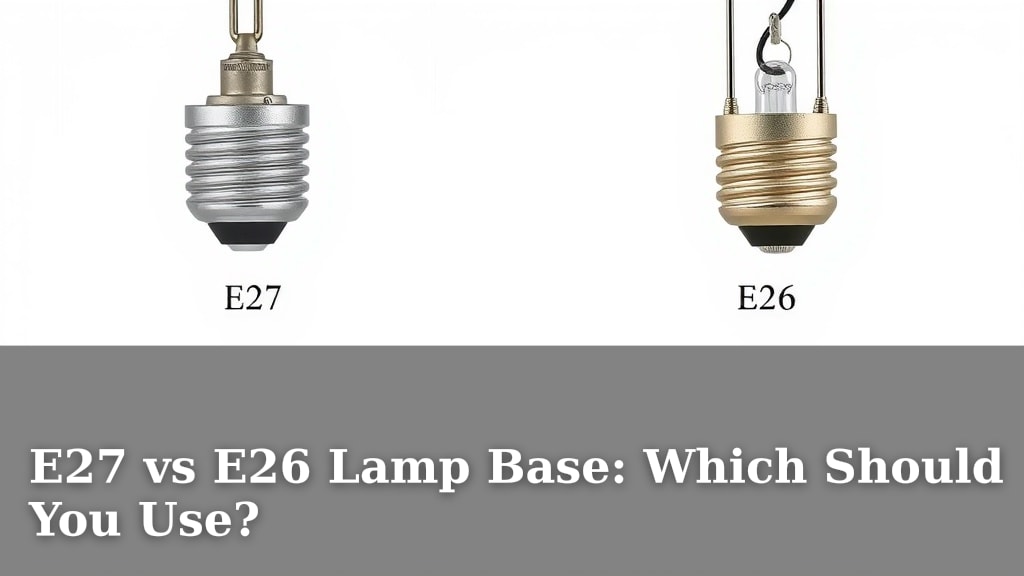
The “E” in E26 and E27 stands for Edison screw. This naming convention honors Thomas Edison and his invention of the screw-in light bulb. The number that follows, 26 or 27, refers to the diameter of the screw base in millimeters. So, E26 is 26 millimeters in diameter, and E27 is 27 millimeters.
The Slight Diameter Discrepancy
This is where the main physical difference lies. The E27 base is actually 1 millimeter wider than the E26 base. While this might sound like a lot, it’s a very small difference in the grand scheme of things. It’s barely noticeable to the naked eye.
Geographical Standards: Where Are They Used?
The primary reason for the two different sizes comes down to international standards. Different regions adopted slightly different specifications. This is a common occurrence in manufacturing and technology.
E26: The North American Standard
In the United States and Canada, the E26 base is the standard for most screw-in light bulbs. If you’re buying a light bulb in North America, chances are it has an E26 base. This is the go-to for your lamps, ceiling fixtures, and anywhere you’d typically screw in a light bulb.
E27: The European and Global Standard
Across Europe, Australia, and many other parts of the world, the E27 base is the prevailing standard. If you’ve ever bought light bulbs while traveling abroad or ordered fixtures from overseas, you might have encountered the E27. It’s widely used in over 120 countries (International Electrotechnical Commission).
Interchangeability: Will They Fit?
This is the million-dollar question for many people. Because the size difference is so small, E26 and E27 bulbs often work interchangeably. It’s not uncommon for an E26 bulb to screw snugly into an E27 socket, and vice-versa. This is largely due to slight variations in manufacturing tolerances.
Think of it like trying to fit two slightly different-sized Lego bricks together. Sometimes they click perfectly, and sometimes you have to give them a little nudge. Manufacturers allow for a small margin of error, which, in this case, makes them mostly compatible.
When to Be Cautious
While they often interchange, it’s not a guarantee. In some cases, an E26 bulb might be a bit too loose in an E27 socket, or an E27 bulb might be too tight to screw in fully into an E26 socket. Forcing a bulb can cause damage to the socket or the bulb itself. It could also create a safety hazard.
We found that relying on interchangeability can lead to problems, especially if you’re dealing with specialized fixtures or importing items. It’s always better to be certain.
Key Differences Summarized in a Table
To make it even clearer, let’s look at a quick comparison:
| Feature | E26 Base | E27 Base |
|---|---|---|
| Diameter | 26 mm | 27 mm |
| Primary Region | North America (USA, Canada) | Europe, Australia, and many other countries |
| Common Name | Medium Screw Base, Standard Base | Edison Screw, Standard Screw |
| Interchangeability | Often fits E27 sockets | Often fits E26 sockets |
Safety First: Why Compatibility Matters
While the electrical voltage is often the same (120V in North America for E26, 220-240V in Europe for E27), the physical fit is what we’re focusing on here. Using a bulb that doesn’t fit correctly can lead to:
- Poor electrical contact: This can cause flickering lights or the bulb not to light up at all.
- Overheating: A loose connection can increase resistance, generating unwanted heat. This is a fire risk.
- Damage: You could strip the threads on the bulb or the socket if you force it.
The National Electrical Code (NEC) emphasizes proper component compatibility for electrical installations (NEC Article 110.3(B)). Ensuring your bulb base matches your socket is a fundamental part of safe electrical use.
How to Choose the Right Base for Your Needs
So, how do you make sure you’re using the right bulb? It’s simpler than you might think. Here’s a quick checklist to help you out:
Your Go-To Checklist for Bulb Bases
- Check the Fixture: Look at the existing bulb or the socket itself. Sometimes the base type is printed nearby.
- Inspect the Bulb Packaging: Most new bulbs clearly state the base type on the box. Look for “E26” or “E27.”
- Consider the Origin: If your light fixture is from North America, it’s almost certainly E26. If it’s from Europe or elsewhere, it’s likely E27.
- When in Doubt, Measure: If you can safely remove the bulb, a quick measurement of the widest part of the screw threads will tell you if it’s closer to 26mm or 27mm.
- When Importing, Be Sure: If you’re buying bulbs or fixtures from a different country, always verify the base type to avoid compatibility issues.
- Err on the Side of Caution: If you’re unsure, it’s best to get a bulb that is definitively labeled for your region or the socket you’re using.
Conclusion
Navigating the E26 vs. E27 bulb base is simpler than you might think. Remember, the E26 is your standard in North America, while the E27 is common across Europe and much of the globe. While they often swap out thanks to manufacturing flexibility, it’s not a foolproof system. Your best bet is always to confirm compatibility with your fixture to ensure a safe and secure connection. Don’t guess with your lighting; a quick check can save you hassle and prevent potential electrical issues.
Frequently Asked Questions
Can I use an E27 bulb in a North American lamp?
You often can, as the size difference is minimal. However, it’s not a guaranteed fit. If the E27 bulb feels too tight or won’t screw in completely, don’t force it. It’s safer to find an E26 bulb designed for your North American socket to ensure a proper electrical connection.
Will an E26 bulb work in a European fixture?
Similar to the above, an E26 bulb might screw into an E27 socket. But, a loose fit could lead to flickering or overheating. It’s best practice to use an E27 bulb if your fixture is from Europe or another region that uses the E27 standard to avoid any safety concerns.
What happens if I use the wrong base size?
Using a bulb with an incompatible base can lead to poor electrical contact, causing lights to flicker or not turn on. More seriously, a loose connection can generate excess heat, posing a fire hazard. You could also damage the bulb or socket threads by forcing it.
Is the voltage different for E26 and E27 bulbs?
The base size itself (E26 vs. E27) is a physical dimension and doesn’t dictate voltage. E26 bulbs are typically designed for North America’s 120V standard, while E27 bulbs are often used in regions with 220-240V. Always check the bulb’s packaging for its voltage rating to match your home’s electrical system.
How can I tell if my socket is E26 or E27 without removing the bulb?
It can be tricky without a direct measurement. Your best bet is to check the fixture’s manual or any labels on the fixture itself. If the fixture is from North America, it’s almost certainly E26. For fixtures from Europe or other international markets, it’s likely E27.


![10 Best Bulb For Desk Lamp [2026]](https://bestdesklamp.com/wp-content/uploads/2026/08/10-best-bulb-for-desk-lamp-2026-featured-768x432.jpg)