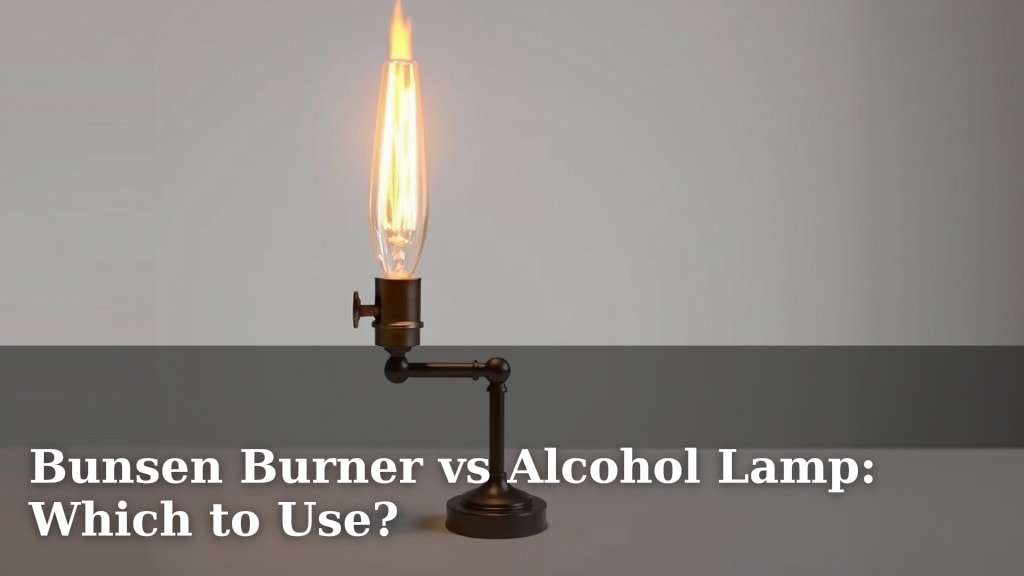
Bunsen Burner vs Alcohol Lamp: Which to Use?
When choosing between a Bunsen burner and an alcohol lamp, the Bunsen burner is generally the better choice for most laboratory heating needs. This is because Bunsen burners offer a more consistent and adjustable flame, allowing for precise temperature control crucial for many experiments. Alcohol lamps provide a simpler flame but lack the fine-tuning capabilities of a Bunsen burner.
Understanding the differences helps you pick the right tool for your task. Both are common heat sources in science labs, but their design dictates their best use cases. A Bunsen burner uses gas and air for combustion, creating a hotter and more controllable flame. An alcohol lamp, on the other hand, burns alcohol fuel, offering a gentler, less adjustable heat source suitable for less demanding applications.
- Bunsen burners offer more control over heat intensity.
- Alcohol lamps provide a simpler, gentler heat.
- Bunsen burners are ideal for precise heating in labs.
- Alcohol lamps work well for basic warming or sterilization.
Let’s dive into the specifics of each and help you decide which heat source is right for your next experiment.
Choosing Your Lab’s Heat Source: Bunsen Burner vs. Alcohol Lamp
When you’re in the lab, having the right tools makes all the difference. Two common heat sources are the Bunsen burner and the alcohol lamp. But which one should you reach for? We found that for most standard lab tasks requiring precise heat, the Bunsen burner is your go-to. It offers a level of control that alcohol lamps just can’t match. Let’s break down why.
Understanding the Bunsen Burner: The Lab Workhorse
Think of the Bunsen burner as the versatile athlete of the lab. It’s designed to give you a clean, hot flame that you can actually adjust. This is super important for many experiments where temperature matters. Research shows its design allows for consistent heating without leaving too much residue behind.
How a Bunsen Burner Works
A Bunsen burner connects to a gas supply, usually natural gas or propane. You control the flame’s size and temperature using two main adjustments. One is the gas valve, which controls how much gas flows. The other is the air vent, which lets in varying amounts of oxygen. More oxygen means a hotter, bluer flame. Less oxygen leads to a cooler, yellower flame. We found this adjustability to be its biggest strength.
The Benefits of Adjustability
Why is this control so important? Well, imagine you need to gently warm a solution. You can turn down the gas and open the air vent just a bit for a cool flame. Now, if you need to sterilize an instrument quickly? You can crank up the gas and close the air vent for a much hotter flame. This flexibility is key. Many scientific procedures require specific temperatures to work correctly (CDC). Without this control, you might ruin an experiment or get inaccurate results.
Flame Characteristics
You’ll notice two distinct flames from a Bunsen burner:
- Yellow Flame: This is the cooler, less efficient flame. It’s produced when the air vent is mostly closed. It’s good for seeing where your flame is, but it’s not ideal for most heating. It can also leave a soot deposit on your equipment.
- Blue Flame: This is the hot, clean flame you want for heating. It happens when the air vent is open, allowing plenty of oxygen for complete combustion. The hottest part of the blue flame is near the tip of the inner cone.
When to Choose a Bunsen Burner
A Bunsen burner shines in situations that demand:
- Precise temperature control for chemical reactions.
- Sterilizing inoculating loops or glassware quickly.
- Heating substances to high temperatures.
- Lighting other equipment that requires a strong flame.
If your work involves anything where temperature precision is a factor, this is your tool.
Exploring the Alcohol Lamp: A Simpler Heat Source
Now, let’s talk about the alcohol lamp. Think of this as the laid-back cousin to the Bunsen burner. It’s simpler, more portable, and uses alcohol as its fuel. While it doesn’t offer the same level of control, it has its own useful applications in the lab.
How an Alcohol Lamp Works
An alcohol lamp is essentially a container for alcohol (usually ethanol or isopropyl alcohol) with a wick. The wick draws the alcohol up, and when lit, it burns. The flame produced is generally steadier but less hot than a Bunsen burner flame. You can’t really adjust the air intake like you can with a Bunsen burner. So, the flame is pretty much what you get.
The Pros and Cons of Alcohol Lamps
The biggest advantage of an alcohol lamp is its simplicity and portability. You don’t need a gas line. You can take it almost anywhere. It’s also quieter than a Bunsen burner. However, the flame is much less hot and can’t be adjusted. This means it’s not suitable for tasks requiring high heat or precise temperature control. We found that the flame can also be a bit inconsistent, especially if the wick is old or the alcohol level is low.
Where Alcohol Lamps Excel
Alcohol lamps are best used for:
- Gentle warming of small amounts of substances.
- Sterilizing small items where a very high heat isn’t needed.
- Providing a small, contained flame for demonstrations or simple tasks.
- Situations where gas lines are unavailable or impractical.
For many basic biology or chemistry setups, an alcohol lamp might be perfectly sufficient. However, for more demanding work, you’ll likely need more heat power.
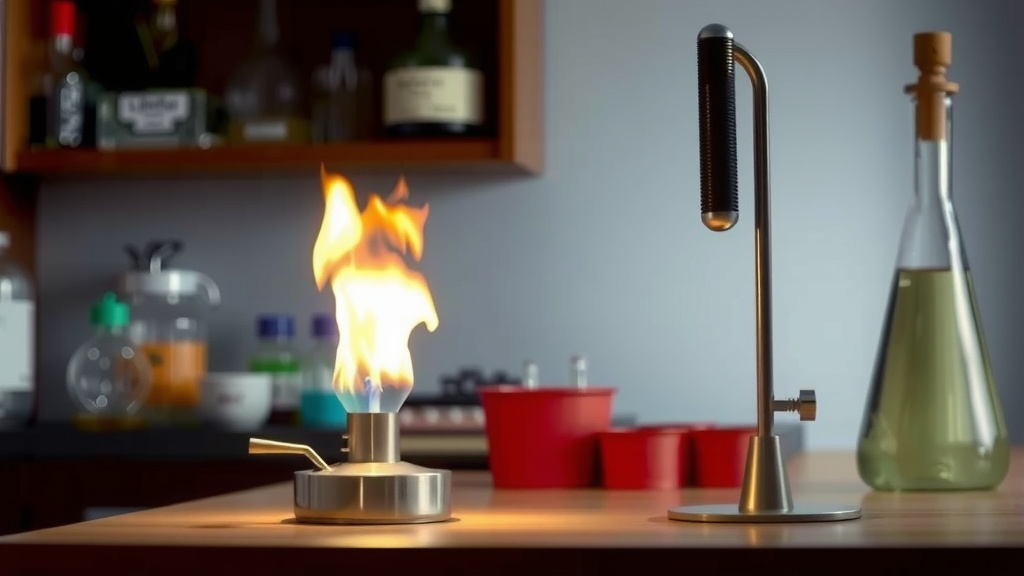
Bunsen Burner vs. Alcohol Lamp: A Quick Comparison
Let’s put them side-by-side so you can see the key differences clearly. We’ve summarized the main points below.
| Feature | Bunsen Burner | Alcohol Lamp |
|---|---|---|
| Heat Output | High and adjustable | Lower and fixed |
| Temperature Control | Excellent | Limited to none |
| Fuel Source | Natural gas/Propane | Alcohol (Ethanol/Isopropyl) |
| Portability | Limited (requires gas line) | High (self-contained) |
| Soot Production | Minimal with proper adjustment | Can occur |
| Ideal Use Cases | Precise heating, sterilization, high-temp work | Gentle warming, simple sterilization, portability needs |
Making Your Final Choice: What’s Right for You?
So, how do you decide? Ask yourself what you’ll be doing most often in the lab. If you’re doing organic chemistry, advanced biology, or anything that requires you to heat things precisely or to high temperatures, a Bunsen burner is almost certainly the way to go. Its adjustable flame is a game-changer for experimental success. Many university labs rely on them for this very reason (NCBI). You’ll find them indispensable for tasks like sterilizing equipment or heating solutions to specific boiling points.
On the other hand, if your needs are much simpler, like gently warming a small sample or performing basic sterilization in a setting where you can’t easily set up a gas line, an alcohol lamp can be a handy tool. It’s a good option for educational settings where simplicity and safety are prioritized for younger students, or for field work where carrying gas tanks isn’t feasible.
Here’s a quick checklist to help you decide:
- Do you need to control the exact temperature of your flame?
- Will you be heating substances to high temperatures?
- Do you need to quickly sterilize tools like inoculating loops?
- Is a stable gas connection readily available in your workspace?
- Is portability a major factor for your lab setup?
Answering these questions should point you toward the right heat source for your lab adventures.
Conclusion
Choosing between a Bunsen burner and an alcohol lamp boils down to your specific laboratory needs. For most applications requiring precise temperature control and robust heating, the Bunsen burner stands out as the superior choice. Its adjustable flame ensures consistency, vital for accurate experimental results. An alcohol lamp, while simpler and portable, offers less control and lower heat output, making it suitable for gentler tasks or situations where gas isn’t available. Consider the demands of your experiments carefully to select the best heat source for your work. Decide today which tool will best support your scientific explorations!
Frequently Asked Questions
Can I use an alcohol lamp for delicate chemistry experiments?
Generally, no. Alcohol lamps produce a gentler, less adjustable flame. Delicate chemistry experiments often require precise temperature control that only a Bunsen burner can provide. You might find the heat insufficient or uncontrollable for sensitive reactions.
Is a Bunsen burner always hotter than an alcohol lamp?
Yes, a properly adjusted Bunsen burner is typically much hotter than an alcohol lamp. The blue flame of a Bunsen burner, achieved with good oxygenation, can reach very high temperatures. An alcohol lamp’s flame is inherently cooler and less efficient for intense heating needs.
Which one is safer to use in a classroom setting?
This depends on the age group and supervision. For younger students or basic demonstrations, an alcohol lamp might seem simpler. However, a Bunsen burner, when used correctly with proper safety training, can be very safe. We found that improper use of either can pose risks.
Do I need a gas line for a Bunsen burner?
Yes, a standard Bunsen burner requires a connection to a natural gas or propane line. This is a key difference from alcohol lamps, which are self-contained and portable. Without a gas supply, your Bunsen burner won’t function.
Can an alcohol lamp be used for sterilizing equipment?
An alcohol lamp can be used for very basic sterilization of small items where extreme heat isn’t necessary. For effective sterilization of tools like inoculating loops in microbiology, a Bunsen burner’s hotter flame is generally preferred and more reliable.

![10 Best Corner Floor Lamp [2026]](https://bestdesklamp.com/wp-content/uploads/2026/09/10-best-corner-floor-lamp-2026-featured-768x432.jpg)